Making a temporary ‘corn’ labyrinth on grass

Image

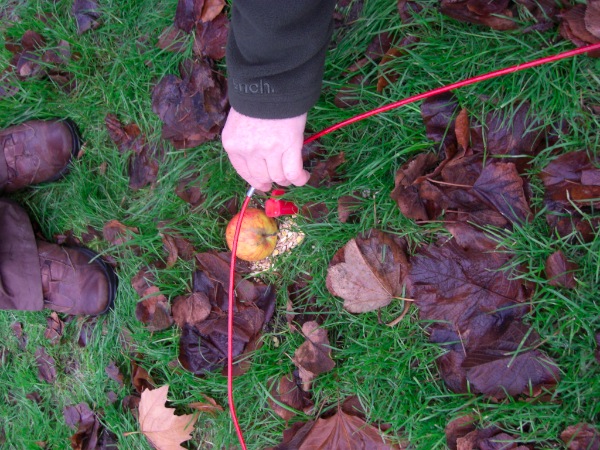
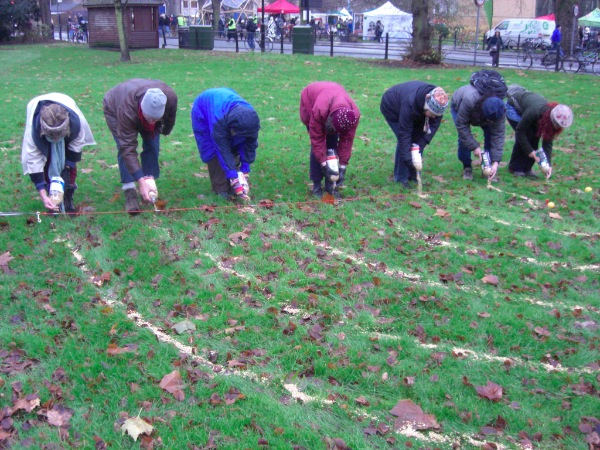
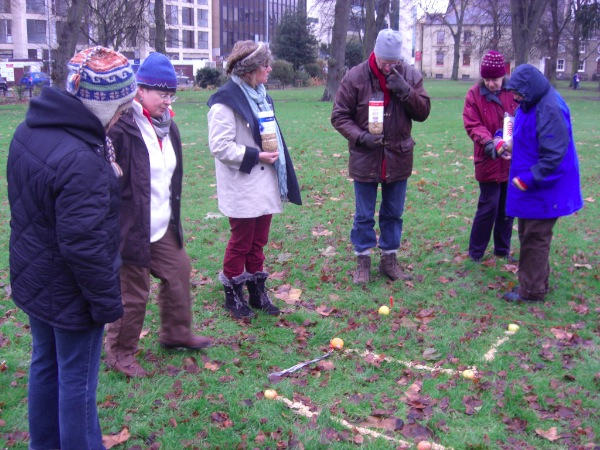
Here are some photos of the process of making an outdoor ‘corn’ labyrinth on grass. The pictures were taken at Mill Road Winter Fair and the ‘aerial view’ one is from the Quiet Waters Christian Retreat House in Suffolk. This method is for making a seven circuit classical (or Cretan) labyrinth. The corn is the kind of ‘mixed corn’ you feed to chickens, and one large sack is just sufficient, providing you are not too generous at the start.

Image

The stake and swivel are the corkscrew-type dog owners use to tether their dog when at the beach or on a picnic. The rope we used is a 6 meter long dog-tether. The path widths are 80cm and the diameter of the labyrinth at the widest point is 12 meters.

 Note, it is necessary to mark the four corners of the initial ‘seed diagram’ with tent pegs. As the rope is drawn round, it snags on the pegs, thus producing a mushroom shape rather than a circle.

 Please check the Labyrinthos site for full instructions – I can confirm they work!

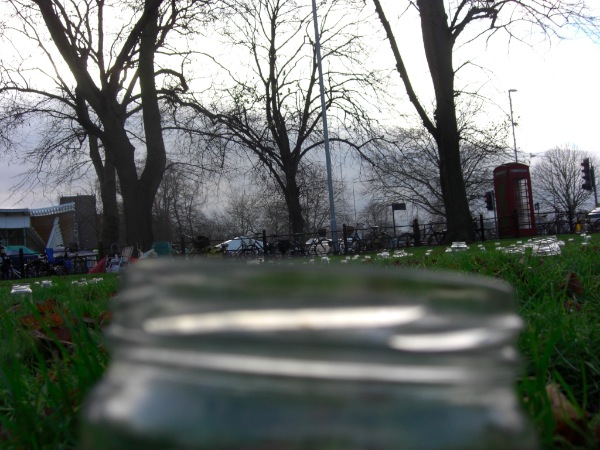
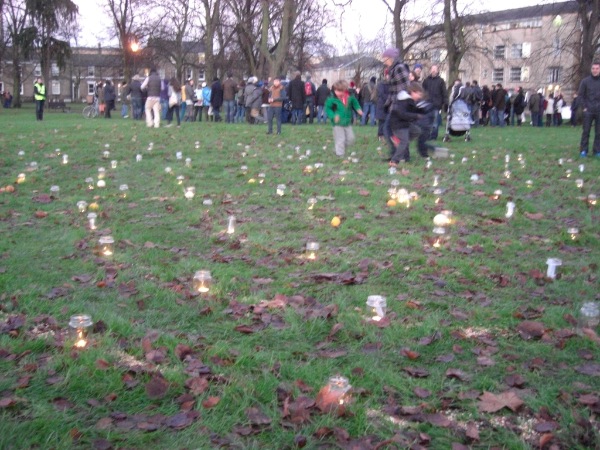
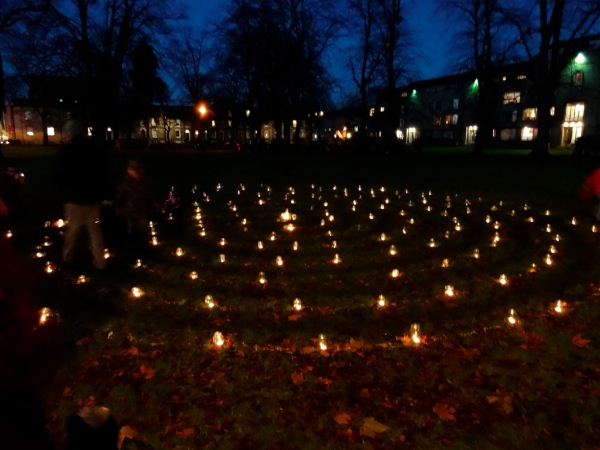
 For the candlelit version of the labyrinth we used tea lights in jam jars. For a different effect, it is also possible to buy brown paper ‘candle bags’ and put some sand and a tea light in each one.

 Image

For our labyrinth, 12 meters in diameter, we used 180 jam jars and tea lights, with a spacing of 80cm.

 Finally, to calculate the length of the ‘walls’ of your labyrinth (more correctly known as the ‘fields’) the rule of thumb is to take the diameter and multiply it by 13.33. 

Image


ImageImageImage

Making a classical labyrinth – animation

Making a classical labyrinth – animation

Please follow this link to see a funky animation of the process of making a seven-circuit classical labyrinth, using a rope attached to a central swivel. The rope is first marked with the path widths, using knots or tape. Note that the first mark on the rope is only half a path width. It only remains for the labyrinth making ‘team’ to follow the marks with corn, sand, masking tape etc. Thank you to Jo Edkins for making and sharing this excellent animation. Also thanks to Jeff Saward and the Labyrinthos site for providing instructions for this method of making a labyrinth. Hours of fun! If you decide to make a corn labyrinth yourself, you will need one sack of mixed corn and seven lemonade bottles cut into scoops… also a willing team of helpers, including a ‘runner’ to keep topping up the corn.

Mill Road Winter Fair Candlelit Labyrinth

Image

Despite a misty and drizzly start, Saturday 1st December turned into a beautiful cold, clear day, perfect for wrapping up warm and joining the wonderfully varied throng in Mill Road for the annual Mill Road Winter Fair.

 This year saw the first ever labyrinth at the fair, and, as the day went on, it proved to be very popular with visitors of all ages, sizes and backgrounds.

 The idea for the labyrinth began on a summer day when I was passing Petersfield on my way to a meeting at Jimmy’s Night Shelter. I noticed the large green space… the benches round about… the encircling mature trees… I thought, how wonderful to make a labyrinth here, which could be walked by Jimmy’s guests and local residents alike, as a symbol of community. Afterwards I remembered the Winter Fair, which seemed the perfect opportunity to put my idea into practice.

 Mill Road Winter Fair committee liked the idea, especially the plan to light the labyrinth pathways with tea lights in jam jars. Jimmy’s and Cambridge Link Up were very pleased for me to raise awareness of their work through making the labyrinth.

 On the day the labyrinth looked truly magical as dusk descended. Gradually more and more people came to walk it. Quite a few were intrigued by the ancient pattern of its circuits and wanted to know more.  Many clearly experienced the meditative quality of the labyrinth for themselves. Youngsters and small children were particularly drawn to it and had a great time racing round it. Darkness fell at 4.00pm, and soon after the arrival of wonderful local Samba Band Arco Iris announced the rousing grand finale of the Fair. 

After all the jars and candles were cleared away, the print of the labyrinth, edged with corn and marked by the tracks of people’s feet, could still be clearly seen… It was, finally, too tempting for me to simply climb into the car and leave behind… I couldn’t resist one last sprint around the paths. It seemed as if the energy all the people who had walked it was focussed there, and I felt my spirit fly…

 Many thanks to all those who helped make the labyrinth, also those who saved up their used jam jars and those who helped put them out and light them on the day. Thanks too to Paul Edwards who took these lovely photos. All being well, we’ll be back again next year!

Image

Image

Hazelnuts of Wisdom

When I first came across the labyrinth, I thought how wonderful it would be to share it with others from all walks of life, including folk who normally find they are marginalised from society. I already had quite a few friends and contacts in the homeless community through my work as a community musician. I was lucky to find a friend at the Cambridge University Botanic Garden who shared my vision, and we set to work turning our idea into reality.

So finally it came to pass, on a very warm Wednesday in August 2012, that a group of homeless and ex-homeless people came as guests to the wonderful green space known as the University of Cambridge Botanic Garden, with the aim of creating and walking a labyrinth, and of spending time enjoying the garden setting.

Our mission was to create a temporary labyrinth, using one 20-kilo sack of mixed corn. This is a mix of bright yellow cracked maze and wheat, of the sort that is very desirable to chickens! The paths of the labyrinth would be edged by a curving trail of this grain, with each trail poured from the mouth of a recycled lemonade bottle.

There is a certain skill to the grain pouring, which generally comes after a few spills and a certain amount of practice! The second skill to learn is that of following your mark on the guide rope as it sweeps round in an arc, fixed at one end to a swivel in the centre of the labyrinth, and held low to the ground at the other end by a slowly circling person – on this occasion by me, crawling on my hands and knees.

The classical labyrinth form is a compelling shape, and as it began to appear, passers-by stopped to watch. Sometimes it seems to me that the labyrinth acts as a net, catching people and animals in its intriguing threads. Our visitors were welcomed in and invited to join us as companions in our walking.  We especially admired the fleet footed running of Lucia! We hoped that many more visitors would walk our labyrinth before the squirrels, birds and mice of the garden nibbled the grains away and it slowly returned to green.

I launched the walk with a short explanation of the three stages of a labyrinth walk:

• ‘releasing’ on the winding path inward;

• ‘receiving’ as you pause, for as long as you like, in the centre…

• ‘returning’ as you wind your way out again, bringing with you whatever you have received.
kernels of wisdom

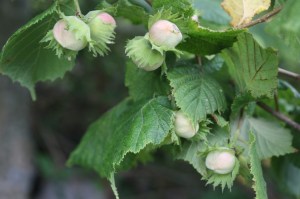
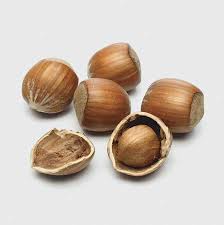
The labyrinth is a great place to receive artistic and poetic inspiration. So we set to work with paper, pens, pastels and crayons to record in some way what we had received and felt in the garden. I also placed a small heap of ripe hazelnuts at the centre of the labyrinth for people to pick up as a keepsake. This seemed appropriate, as the hazelnut is an ancient Celtic symbol of wisdom. The hazelnut is also meaningful in the Christian tradition. The medieval mystic, Julian of Norwich, had a vision in which she saw ‘everything that is’, small as a hazelnut, yet held safely in the palm of God’s hand.

The hazel nuts seemed fitting to take away as a keepsake to remind us of our experience, and I imagine the squirrels were very pleased with the leftovers. Best of all, EVERYONE who came had some positive thought or inspiration to take away from the day. That is truly the gift of the labyrinth, and I was glad to be there to see it happen.
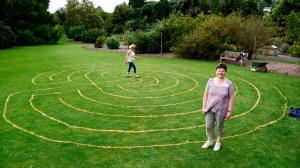
The mixed corn labyrinth, complete and ready to walk.    Photo by Richard Wright
It is solved by walking

Putsborough beach labyrinth

Solvitur ambulando’ ‘It is solved by walking’.

The phrase is attributed to Saint Augustine, but the wisdom is intuitive, as any parent who has ever paced around soothing an unhappy baby knows. If there is a garden or park available for the baby-soothing walk, so much the better. If the walking place is cool and leafy, with a mosaic of light shining through the leaves, chances are the baby will soon be both soothed and entranced. Even indoors, walking works its magic, and mirrors and blowing curtains do the work of sunlight and breeze.

Walking wisdom also pushes through into action at other times, for example, when we are in chronic pain or mental distress. When you wake in the night and lying in your bed is just intolerable, the body takes over and if you have any strength left to do it, you rise and pace the room, up and down or round and round. So we lull away pain and lull ourselves into a quieter state.

The many traditions of walking meditation embody this intuitive walking wisdom. We become grounded in our bodies as we slowly tread the earth beneath our feet. Our minds are momentarily freed of busy thoughts and worries, which fly free like doves from a pigeon loft. Later on, when they return to roost, they are calmer, more settled.

In this pathway blog I will share some thoughts about life’s journey and some of the things which come up for me along the way. Some of the pages will be about my work with the labyrinth. I hope to give something of the flavour of this special yet simple form of walking meditation. Perhaps you will be inspired to visit a labyrinth yourself. Even a simple circling walk around your garden, approached quietly and slowly, can give something of the feel of the prayer labyrinth.

As TS Eliot wrote in his poem Little Gidding: ‘We shall not cease from exploration, and the end of all our exploring will be to arrive where we started and know the place for the first time’.

And never forget, as Laurie Anderson has so beautifully pointed out in her ‘Walking and Falling’, with each step we take, we are really falling, and catching ourselves from falling, over and over…

You’re walking. And you don’t always realize it,

but you’re always falling.

With each step you fall forward slightly.

And then catch yourself from falling.

Over and over, you’re falling.

And then catching yourself from falling.

And this is how you can be walking and falling

at the same time.